Driving operation optimization
Smooth control of vehicle speed and steering
When operating in a narrow channel, try to maintain a stable speed to avoid sudden acceleration or sudden braking, which will instantly increase the battery discharge current and increase energy consumption. At the same time, when steering, you need to anticipate in advance and turn the steering wheel slowly to reduce the energy loss of the steering system, especially in a small space. Frequent steering, pay more attention to moderate strength to avoid excess power consumption.
Plan the job path reasonably
Before the operation, it is necessary to combine the warehouse layout and the storage location of the goods to plan the optimal driving route to reduce unnecessary round trips and detours. For example, according to the order of access of the goods, plan to complete the operation of multiple points at one time to avoid repeated entry into the narrow channel and reduce the waste of energy consumption caused by invalid driving.
Precise control of the fork
When picking up goods, it is necessary to accurately align and avoid repeatedly adjusting the position of the fork. At the same time, when lifting the fork, a reasonable height should be controlled to only meet the loading and unloading needs. Excessive lifting height will increase the load of the hydraulic system, which in turn consumes more power.
Battery daily maintenance management
Regularly check the battery status
Check the voltage, temperature and other parameters of the battery before and after daily operation to ensure that the battery is in the normal working range. If abnormal voltage fluctuations are found, the cause should be checked in time to avoid increased energy consumption due to battery performance degradation. At the same time, pay attention to the heat dissipation of the battery and avoid continuous operation in a high temperature environment. High temperature will accelerate the internal chemical reaction of the battery and increase energy consumption.
Scientifically control the charging rhythm
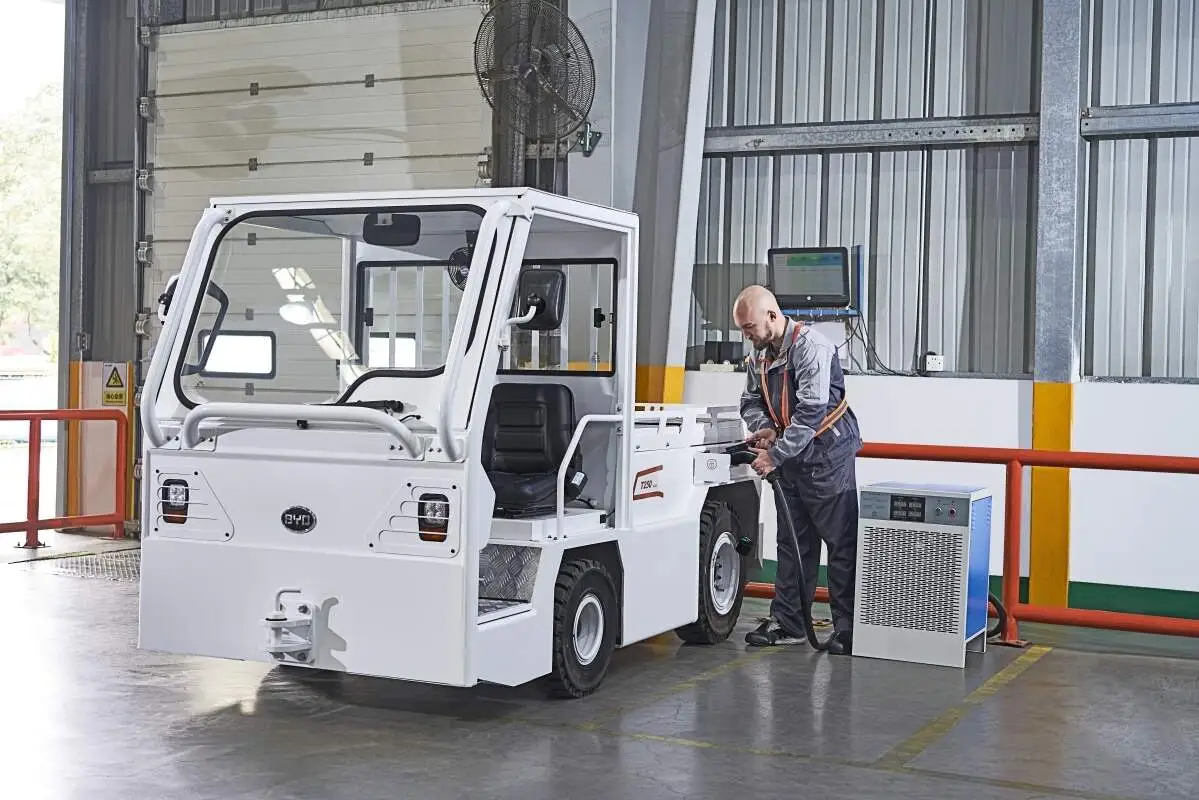
Follow the principle of "shallow charge and shallow discharge" to avoid booster charging after the battery is completely exhausted, and do not overcharge for a long time. When the battery power is about 20% remaining, the charging can be arranged, and the power supply can be disconnected in time after the charging is completed, which can prolong the battery life, maintain a stable discharge efficiency, and reduce energy consumption fluctuations in long-term operation.
Clean battery peripherals
Regularly clean the dust and debris on and around the battery surface to keep the battery heat dissipation channel open. Dust accumulation will affect the battery heat dissipation, resulting in an increase in the battery operating temperature, which not only increases energy consumption, but also may affect battery performance.
Equipment regular adjustment and maintenance
Check tire condition
Regularly check the air pressure and wear of the forklift tires to ensure that the air pressure meets the standards and avoid increasing the driving resistance due to insufficient air pressure, resulting in an increase in energy consumption. If the tires are excessively worn, replace them in time to ensure the stability of the forklift and reduce additional power consumption.
Calibration of lifting hydraulic system
Regularly calibrate the pressure parameters of the lifting hydraulic system to ensure the smooth operation of the hydraulic components, avoid frequent overload of the hydraulic system due to abnormal pressure, and increase power consumption. At the same time check the status of the hydraulic oil, replace the deteriorated hydraulic oil in time to improve the operating efficiency of the system.
Clear the passage of obstacles
Clean up the debris and deposits in the narrow passage in time before operation to ensure smooth passage, avoid frequent avoidance or deceleration of forklifts during driving, and reduce unnecessary energy consumption losses.